
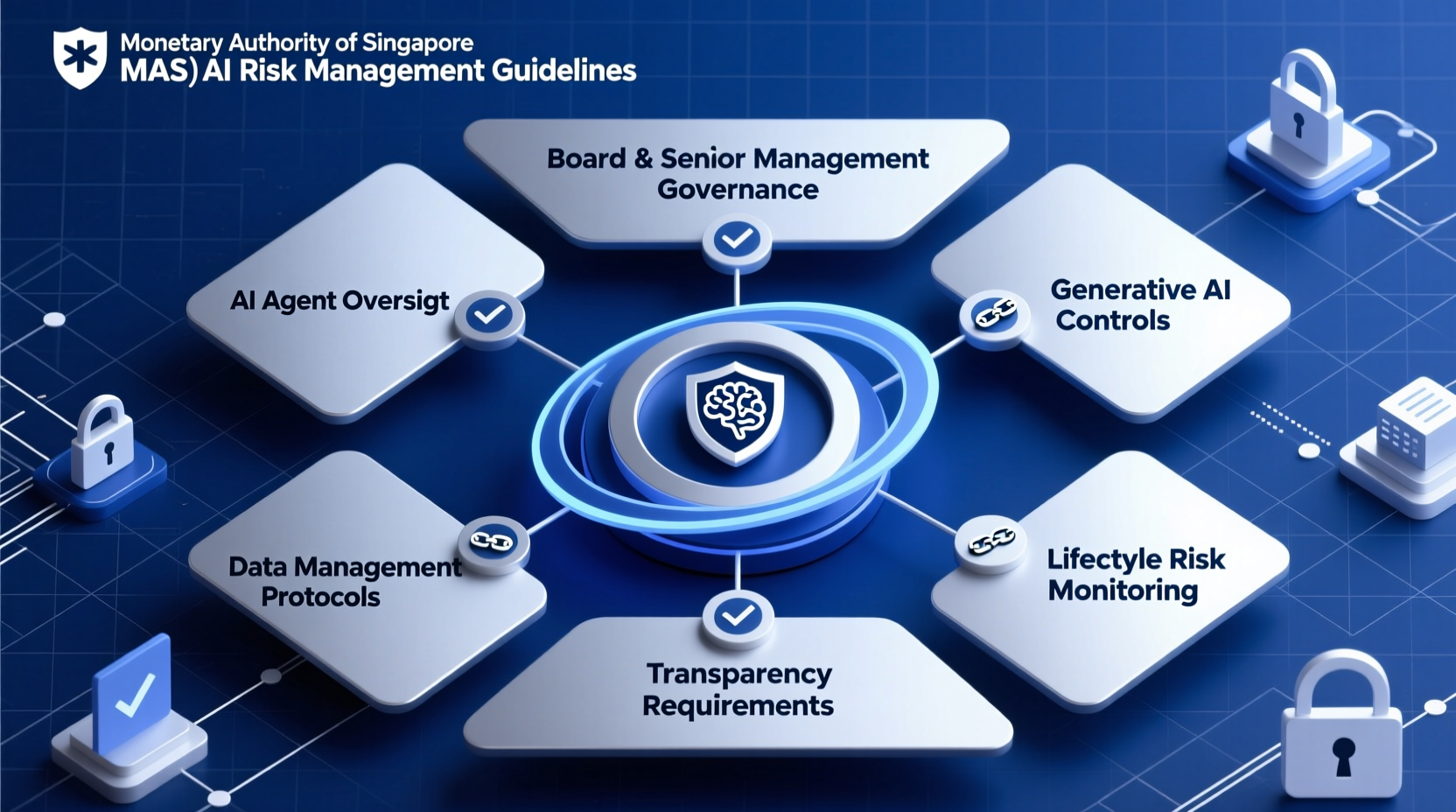
The Monetary Authority of Singapore (MAS) has issued new AI Risk Management Guidelines, outlining stricter expectations for banks deploying artificial intelligence across their operations. The guidelines place direct responsibility on board members and senior management, making AI governance a top-level accountability issue.
The framework details supervisory expectations across several core areas, including AI oversight structures, risk management policies, life-cycle controls, and organisational capabilities needed to safely integrate AI. The guidelines cover a broad spectrum of technologies—from traditional machine learning to Generative AI and emerging AI agents.
Central to the rules is a strengthened governance model. MAS expects bank leadership to set clear frameworks and risk cultures around AI, maintain updated AI system inventories, and carry out robust risk materiality assessments that consider impact, complexity, and reliance levels.
To manage AI risks across its lifecycle, banks will be required to implement controls in critical areas such as data quality, fairness, transparency, explainability, human oversight, third-party vendor risk, testing, monitoring, and change management.
Ho Hern Shin, MAS deputy managing director, said the guidelines provide “clear supervisory expectations” that promote responsible innovation while ensuring AI risks are adequately mitigated. MAS is currently seeking industry feedback, with comments due by 31 January 2026.
Editor’s Analysis
MAS’s new guidelines reflect the regulator’s long-standing strategy: embrace innovation early, but regulate it firmly. With AI rapidly reshaping financial services—from underwriting to fraud detection to customer engagement—the stakes are rising, and regulators are responding with more granular requirements.
By holding boards and senior executives directly accountable, MAS is making a clear statement: AI governance is no longer a technical issue—it is a strategic and fiduciary responsibility. This aligns with global trends, particularly in the EU and UK, where AI oversight is increasingly tied to senior manager accountability frameworks.
The inclusion of Generative AI and AI agents is particularly notable. MAS is signaling that banks must prepare not only for current AI models but also for the next generation of autonomous, decision-making systems. Few regulators have explicitly addressed AI agents yet, putting Singapore ahead of many international peers.
Operationally, the new requirements—such as maintaining AI inventories and conducting materiality assessments—will force banks to take a more structured and auditable approach to AI deployment. This will likely raise compliance costs in the short term but could reduce systemic risks and enhance consumer trust in the long run.
Overall, MAS is setting a benchmark for responsible AI adoption in finance, balancing innovation with accountability. Other jurisdictions may follow with similar frameworks as AI becomes integral to bank operations.







Leave a Reply