
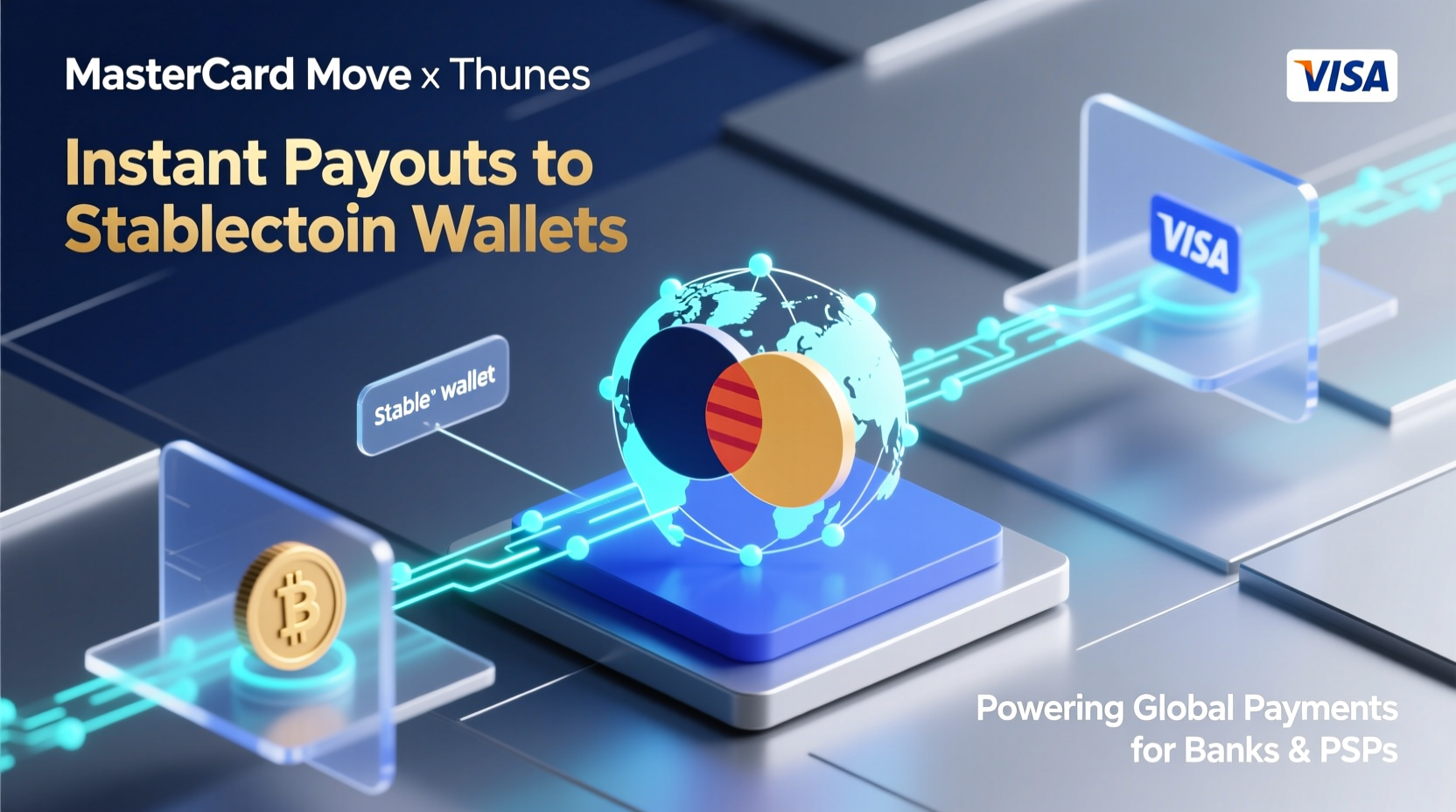
Mastercard Move has partnered with global payments infrastructure provider Thunes to enable near-instant payouts directly to stablecoin wallets, expanding Mastercard’s cross-border capabilities into digital currency rails.
Through Thunes’ Direct Global Network, banks and payment providers connected to Mastercard Move can now offer stablecoin wallet payouts alongside traditional endpoints such as bank accounts, cards, and cash pick-up locations. The feature leverages Thunes’ recently launched Pay-to-Stablecoin-Wallets product, which taps rising global demand for fast, 24/7 settlement in digital dollars and other stable assets.
Pratik Khowala, Mastercard’s Global Head of Transfer Solutions, said:
“With Mastercard Move, we already enable transfers in 150 currencies to more than 15 billion endpoints. Now, we’re adding stablecoin wallets to that mix. It’s all about giving end-users more choice and unlocking new possibilities for banks and payment service providers as digital currencies continue to grow.”
The announcement comes just one day after Visa revealed pilot trials for USD-backed stablecoin payouts to creators and gig-economy workers—highlighting an escalating race among global card networks to integrate stablecoin capabilities into mainstream payment flows.
Editor’s Analysis
Mastercard’s integration of stablecoin wallet payouts marks a significant acceleration in the convergence between traditional payment networks and digital-asset infrastructure. While both Mastercard and Visa have spent years experimenting with blockchain technology, recent moves signal a shift from experimentation to commercial deployment.
The partnership with Thunes positions Mastercard to capture the rapidly growing remittance and B2B payments segments where stablecoins already have strong traction due to lower fees, faster settlement, and 24/7 availability. With billions of dollars in annual remittance volume already flowing through stablecoins—particularly USDC and USDT—this expansion allows Mastercard to remain competitive against crypto-native networks like Stellar, Ripple, and emerging on-chain settlement layers.
The timing, just a day after Visa’s announcement, underscores a strategic rivalry: both networks are racing to become the primary bridge between the fiat financial system and tokenised money. However, Mastercard’s move may offer broader reach, given its large distribution footprint and existing relationships with regulated financial institutions.
For banks and PSPs, adding stablecoin endpoints could open new revenue streams—especially in markets where traditional banking is fragmented, settlement windows are limited, or cross-border transfers remain costly. Still, regulatory scrutiny around stablecoins remains high, meaning compliance, AML controls, and on/off-ramp security will be critical for adoption at scale.
In essence, Mastercard’s latest move signals a future where stablecoins are no longer peripheral to global payments—they’re becoming a mainstream settlement option, integrated directly into the largest financial networks in the world.






Leave a Reply